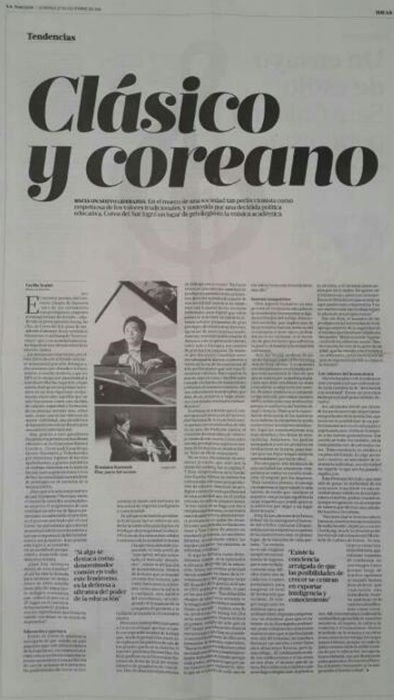
아르헨티나 유력일간지가 한국 클래식 음악에 대해 1개면을 할애(割愛)하는 특집기사를 게재했다.
아르헨티나 최대 일간지 '라 나시온(La Nacion)'은 구랍(舊臘) 27일 쇼팽 콩쿠르와 부조니 콩쿠르 등 세계 무대를 석권하고 있는 한국의 클래식 음악을 대대적으로 소개해 눈길을 끌었다.
이번 특집에서 라 나시온은 "한국은 완벽주의와 전통적 가치를 존중하는 문화, 분명한 정책과 교육을 기반으로 클래식 음악 분야에서도 '코리안 붐'을 확대하고 있다"고 보도했다.
한국을 '지식 수출의 리더 국가'라고 평가한 라 나시온은 "협소한 국토 면적과 천연 자원의 부재에도 불구하고 박근혜 정부가 교육과 개방의 두 가지 패러다임을 경제와 문화 등 제반 분야에 적극 적용하면서 세계 경제 13위를 고수하고, 클래식 음악 분야에서도 신흥 강자로서 입지를 굳혔다"고 분석했다.
이어 "한국 사회구성원들은 교육을 절대적인 가치로 두고있으며, 사회적 차원의 노력에 집중하고 있다"면서 "전쟁과 굶주림, 외세의 침공 등을 겪었던 부모 세대는 자녀 교육에 헌신하며, 목표 달성을 위해 노력하는 사회적 분위기가 조성되어, 경쟁을 통한 선 순환적 발전이 거듭된다"고 덧붙였다.
특히 "한국의 클래식 음악가들은 부조니, 제네바, 클리블랜드 등 국제 유수 콩쿠르 등을 국제 무대로 진출하는 플랫폼으로 적극 활용하고 있다"며, 이는 유명 오케스트라와 지휘자, 유력 클래식 음악 에이전시 등이 없는 한국이 세계의 편견을 극복하고 성공 모델로 나아가는 좋은 사례"라고 평가했다.
이와 함께 "상호존중, 교육의 중요성, 휴머니즘의 가치와 풍류를 아는 '선비 정신'도 한국 클래식 음악의 발전에 일조했다"고 언급했다.
라 나시온은 한국예술종합학교 김대진 교수를 필두로 한국 출신의 세계적인 마에스트로들이 후학 양성을 위해 외국에서 공부한 후 자발적으로 귀국해 재능을 반환하고 있으며, 한국예술종합학교 음악원의 경우 22년이라는 비교적 짧은 역사에도 불구하고 수많은 국제 콩쿠르 수상자들을 배출하는 진원지(震源地)로 성장했다는 내용도 소개했다.
남미의 문화 강국 아르헨티나는 서구 지향의 국민성으로 인해 최근까지 '한류 사각지대'로 분류되어왔으나, 지난 2012년부터 아르헨티나 대사관 중남미한국문화원이 주최하는 K클래식 시리즈가 큰 반향(反響)을 일으키고 있다.
K클래식은 세계 3대 오페라 극장으로 평가 받는 콜론 극장에서 소프라노 조수미, 피아니스트 백건우, 손민수, 김선욱 등의 공연이 이뤄졌고 올 하반기엔 '라이징 영 코리안 피아니스트 페스티발–3인 3색'을 유망 피아니스트 3인이 연주회를 가져 기대이상의 호평을 받았다.
뉴욕=민지영기자 newsroh@gmail.com
<꼬리뉴스>
La Nación, Argentine's leading conservative paper
La Nación(Nation) was founded as La Nación Argentina on January 4, 1870, by former Argentine President Bartolomé Mitre and associates; until 1914, the managing editor was José Luis Murature, Foreign Minister of Argentina from 1914-1916. The daily was renamed La Nación on August 28, 1945. Enjoying Latin America's largest readership until the 1930s, its daily circulation averaged around 350,000, and exceeded only by Crítica, a Buenos Aires tabloid.[2] The 1945 launch of Clarín created a new rival, and following the 1962 closure of Crítica, and the 1975 suspension of Crónica, La Nación secured its position as the chief market rival of Clarín.
Some of the most famous writers in the Spanish-speaking world: José Martí, Miguel de Unamuno, Eduardo Mallea, José Ortega y Gasset, Rubén Darío, Alfonso Reyes, Jorge Luis Borges, Mario Vargas Llosa and Manuel Mujica Láinez have all appeared regularly in its columns.
Originally published in Bartolomé Mitre's home (today, the Museo Mitre), its offices were moved a number of times until, in 1929, a Plateresque headquarters on Florida Street was inaugurated. The publishing group today is headquartered in the Bouchard Plaza Tower, a 26-story Post-modern office building developed between 2000 and 2004 over the news daily's existing, six-story building.
The director of La Nación, Bartolomé Mitre (the founder's great-great-grandson), shares control of ADEPA, the Argentine newspaper industry trade group, and of Papel Prensa, the nation's leading newsprint manufacturer, with Grupo Clarín, and as such shares in the controversies between Clarín and Kirchnerism that developed during 2008 and 2009.
In early 2012, La Nación bought ImpreMedia, the publisher of El Diario-La Prensa, La Opinión and other US-based Spanish-language newspapers.
La Nación's daily circulation averaged 165,166 in 2012, and still represented nearly 20% of the daily newspaper circulation in Buenos Aires; the paper is also distributed nationwide and around the world.
According to third-party web analytics providers Alexa and SimilarWeb, La Nación's website is the 9th and 17th most visited in Argentina respectively, as of August 2015. SimilarWeb rates the site as the 4th most visited news website in Argentina, attracting almost 32 million visitors per month. <www.en.wikipedia.org>

 뉴욕 :
뉴욕 :  파리 :
파리 :  서울 :
서울 :